
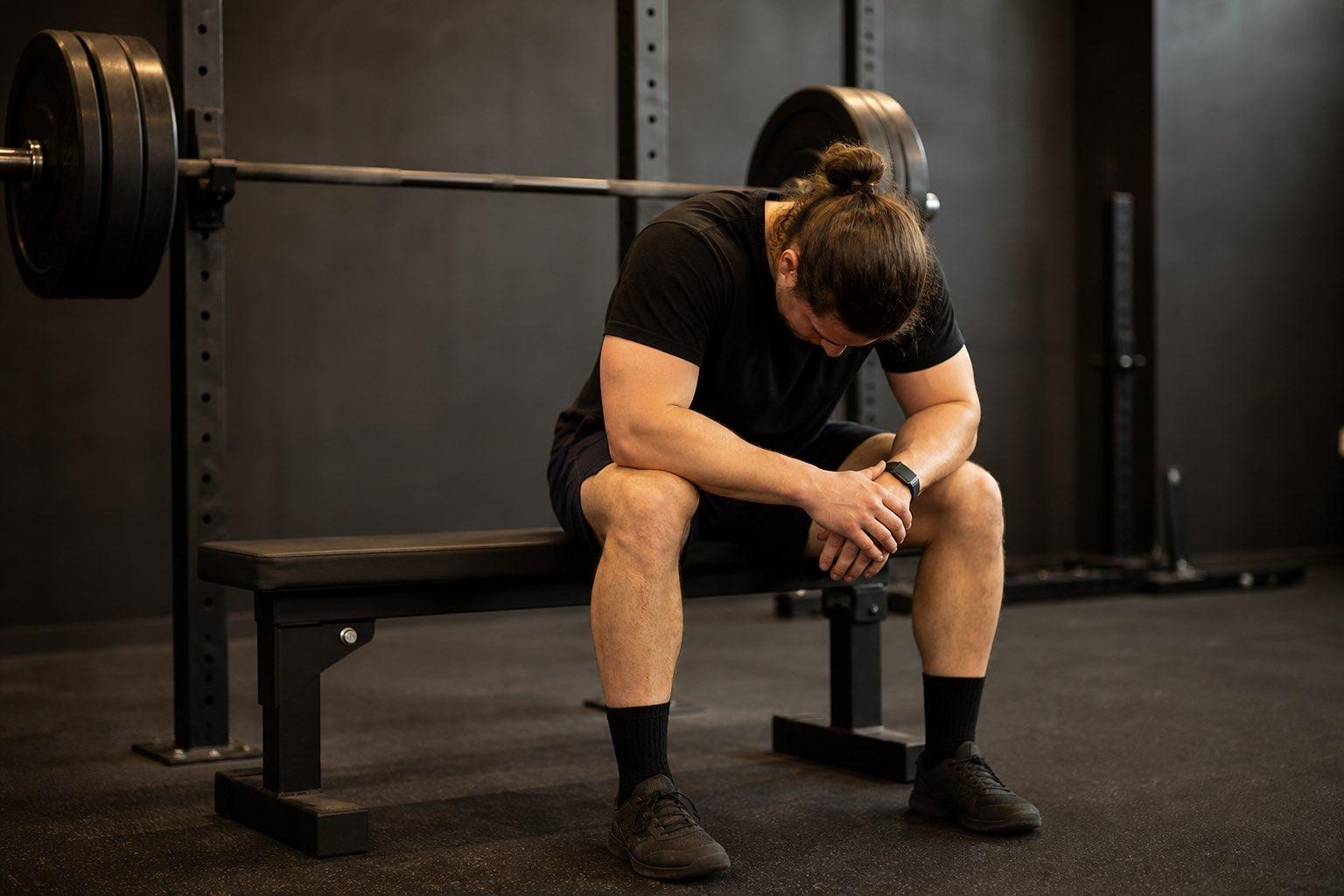
Rest is the one training variable almost nobody writes down, and the advice you have probably read for it is out of date. The widely repeated rule of 30 to 90 seconds for muscle growth comes from a mechanism that was tested and did not hold. Here is what the evidence actually supports, by goal, and what to do when the session is running long.
How long to rest, by goal
| What you are training for | Rest between sets |
|---|---|
| Strength, heavy compound lifts | 3 to 5 minutes |
| Muscle, compound lifts | 2 to 3 minutes |
| Muscle, isolation and machines | 1 to 2 minutes |
| Muscular endurance | 30 to 60 seconds |
| A near maximal single | 5 to 10 minutes |
Two things that table hides, and that the rest of this guide is about. Rest belongs to the exercise, not the session: squats and lateral raises should not share a number. And the muscle row is where the common advice is wrong.
Why you need to rest at all
A hard set is powered mostly by phosphocreatine, a fuel your muscles hold a small amount of and burn through in well under a minute. Refilling it is what rest is for. It comes back fast at first and then slowly: roughly 95 percent is back within about two minutes, and the last few percent take several minutes more.
That curve explains most of the advice below. Two minutes buys you nearly all of your performance back, which is why most training sits around there. The last slice is only worth waiting for when a single rep has to be your absolute best, which is why powerlifters rest so much longer than everyone else.
Rest for strength
This is the clearest finding in the field, and it has been consistent for years: for getting stronger, longer rest wins.
A review of 35 studies found that resting 3 to 5 minutes between sets produced greater gains in absolute strength, because it let people train at higher intensities and higher volumes. An 8 week trial in trained men comparing 1 minute against 3 minutes found significantly greater gains in both squat and bench press one-rep max with the longer rest.
There is an upper bound. When 2 minutes was compared with 5 in trained men with total work matched, the results were similar. So 3 minutes is doing nearly all of the job on most lifts, and the extra minutes are for genuinely maximal attempts.
Rest for muscle
Here is where the standard advice is stale. You have probably read 30 to 90 seconds, often attributed to a need for "metabolic stress". That number is still printed by some of the biggest fitness sites on the internet, and the research no longer supports it.
A 2024 review pooled every controlled trial on rest length and muscle growth. It found a small benefit to resting longer than 60 seconds, and no meaningful difference between anything above about 90 seconds. Its own conclusion is blunt: the usual guidelines prescribing 30 to 90 seconds for muscle growth "warrant reconsideration".
The honest part of that paper is how small the evidence base turns out to be. Nine studies, most of them in untrained people, most of them 5 to 10 weeks long:
| Rest compared | Who | Length |
|---|---|---|
| 60 s vs 150 s | Untrained men | 10 weeks |
| 120 s vs a descending 120 to 30 s | Trained men | 8 weeks |
| 30 s vs 150 s | Untrained adults | 8 weeks |
| 20 s vs 80 s | Untrained women | 5 weeks |
| 60 s vs 180 s | Untrained men and women | 10 weeks |
| 55 s vs 120 s | Untrained men | 7 weeks |
| 60 s vs 180 s | Trained men | 8 weeks |
| 120 s vs a descending 120 to 30 s | Trained men | 8 weeks |
| 60 s vs 240 s | Untrained men over 65 | 8 weeks |
Every one of the pooled estimates had enough uncertainty around it to include "no difference at all". So the practical reading is not "rest 3 minutes to grow". It is: anything above about 90 seconds is fine, under a minute carries a small cost, and the exact number matters far less than people argue about it.
Short rest costs volume, and you can buy it back
The reason short rest costs anything is not mysterious, and it is the most useful fact in this whole topic. Short rest does not harm growth directly. It costs you reps on your later sets, and those lost reps are lost work.
Cut your rest to a minute and your third set drops a rep or two compared with resting three. Do that on every exercise and the week's total work quietly falls. That, rather than anything hormonal, is the likely cost.
Which points at the fix. In one trial, researchers gave the short rest group an extra set to match the total work of the long rest group, and the muscle growth came out similar. So:
- If you have the time, rest 2 to 3 minutes on compounds and take the reps.
- If you do not, cut rest to 60 to 90 seconds and add a set to the exercise. You trade clock time for session time and end up in roughly the same place.
That trade is the answer to the question most people actually have, which is not "what is optimal" but "I have 45 minutes, what do I cut".
Where the 30 to 90 second rule came from
Worth knowing, because you will keep meeting it.
Short rest produces a bigger spike in growth hormone after training. For a while that was taken as evidence that short rest should build more muscle, and it became the standard prescription. Then it was examined properly. A 2014 review found that no study had shown superior growth from shorter rest, one had shown the opposite, and the link from hormones to growth was "largely theoretical".
Then it was tested head on. In a 2016 trial comparing 1 minute against 5 minutes of rest, the short rest group had higher testosterone afterwards and roughly half the muscle protein synthesis in the hours following the session. The hormone spike was real. It simply was not doing what everyone assumed.
Should you time it, or go by feel?
Going by feel works better than it sounds. When fixed rest was compared against letting people choose, performance came out about the same.
The problem is that people are bad at knowing how long they rested. In the trial comparing 1 and 3 minutes, participants who believed they were taking short rests were, once someone timed them, resting considerably longer than they thought. Between sets, a minute of scrolling does not feel like a minute.
So the practical answer is neither pure stopwatch nor pure instinct:
- Time it on your main lifts. The big compounds are where the rest number does real work and where drifting adds up.
- Go by feel on isolation work. When the next set starts when you are ready, you are close enough.
- Check what you actually did, at least occasionally. If your sessions are running 70 minutes for work you planned at 45, rest is nearly always the reason.
A rest timer that knows the exercise
PRZone starts the timer when you finish a set, keeps a separate rest time for each exercise, and lets you add or cut 10 seconds when a set goes badly. Free to start, no ads.
When the session is running long
Rest is usually the first place to find time, and there is a better order than simply cutting everything.
- Trim the isolation work first. Going from 2 minutes to 1 on curls and lateral raises costs you very little and saves real time. Cutting your squat rest from 3 minutes to 1 costs you reps on every set after the first.
- Superset things that do not compete. Pair an upper body push with a lower body or pulling movement and each muscle gets roughly double the rest while the clock runs once. This is the single biggest time saving available and it costs almost nothing.
- Then cut sets, not rest. Once rest is as tight as it can usefully go, three good sets beat five rushed ones.
A note on supersets: pair opposing or unrelated muscles. Supersetting bench press with overhead press is not a time saver, it is just a harder bench session with less rest.
Common mistakes
- One rest time for the whole workout. The most common one. Your squats and your lateral raises do not need the same number.
- Treating 30 to 90 seconds as the muscle building range. It is a time saving range. Anything above 90 seconds is at least as good.
- Cutting rest on your heaviest lift. That is where short rest costs the most reps and where the strength evidence is firmest.
- Letting rest drift without noticing. Two extra minutes per exercise is twenty minutes on a session, and you will swear you were resting ninety seconds.
- Resting by phone. Not because of the phone itself, but because a minute of it feels like twenty seconds and five minutes feels like two.
Frequently asked questions
Is 1 minute enough rest between sets?
It is enough to keep making progress, but it is the point where the cost starts to show. Resting about a minute leaves you fewer reps on your later sets, and the research points to a small advantage for going longer. If a minute is what your schedule allows, keep it and add a set to make up the lost work rather than accepting less.
Can you rest too long between sets?
Not in the way people fear. Nothing goes cold and no benefit is lost at four or five minutes, and powerlifters routinely rest far longer between heavy singles. The real cost is time: past about 3 minutes on most exercises you are paying minutes for very little extra, which usually means fewer sets in the session.
Do shorter rests build more muscle?
No. That idea came from short rest producing a bigger spike in growth hormone, and the hormone spike turned out not to translate into more muscle. When the two were compared directly, short rest produced more testosterone and about half the protein synthesis. Short rest is a way to save time, not a way to grow faster.
Can I use different rest times in the same workout?
You should. Rest is per exercise, not per session. Heavy squats, deadlifts and presses need 3 minutes or more; cable work, curls and lateral raises are fine at 1 to 2 minutes because there is far less to recover from. Setting one rest time for a whole workout means overresting your isolation work or underresting your main lifts.
How long should I rest between exercises?
Usually no longer than between sets of the same exercise, and often less. Moving to a different movement gives the muscles you just trained extra recovery while you set up. The exception is going from one heavy compound lift to another, where the limit is how recovered you feel rather than the clock.
Why do powerlifters rest so long?
Because their goal is the heaviest single rep, and that depends almost entirely on being fully recovered. Phosphocreatine, the fuel for short maximal efforts, comes back to about 95 percent in two minutes but needs several more to finish. For a near-maximal attempt that last few percent is the difference between a make and a miss, so 5 to 10 minutes between top sets is normal.
Track it in PRZone
Log every set, see last session's numbers while you lift, and catch PRs the moment they happen. Free to start on iPhone and Android, with no ads.
Keep reading
 Training guide
Progressive Overload: How to Apply It and Know It Works
The seven ways to make training harder, which one to change first, the three numbers that prove it is working, and what to do when you stall.
 Training guide
RPE and RIR: How Hard Should Each Set Feel?
What the RPE scale means, how it maps to reps in reserve and to a percentage of your 1RM, how accurate your ratings really are, and what to do with them.
 Workout routine
Push Pull Legs Routine: 3 and 6 Day Plans
A complete push pull legs routine with 3 and 6 day schedules, sets and reps for every exercise, and a simple way to add weight week after week.