
Every training guide tells you to add weight. Almost none of them tell you how much, how often, or how to know whether the extra weight is doing anything at all. This guide covers the seven ways to make training harder, which one to change first, the three numbers that prove it is working, and exactly what to do when the bar stops moving.
What is progressive overload?
Progressive overload means gradually giving your body more work than it is used to, so it has a reason to adapt. Lift the same weight for the same reps every week and your body has already handled that job, so nothing needs to change. Ask for slightly more and it responds by building strength and muscle.
The word people misread is gradually. Progressive overload is not a rule that you must beat last session every time you walk into the gym. Over a month the trend goes up. Inside that month plenty of sessions are flat, and some are worse than the one before. That is normal training, not failure.
It is also not only about weight. Load is the easiest thing to see, which is why it gets all the attention, but it is one of seven levers.
The seven levers
| Lever | How to change it | Use it when |
|---|---|---|
| Weight | Add the smallest increment available | You reached the top of your rep range on every set |
| Reps | Add 1 to 2 reps to a set | The weight is right but you are mid-range |
| Sets | Add 1 set to the exercise | You recover well and want more volume |
| Rest | Cut 15 to 30 seconds between sets | You want more work in the same session length |
| Range of motion | Go deeper or fuller on every rep | Your technique runs out before the weight does |
| Tempo | Lower the weight for 2 to 3 seconds | You cannot add load, such as on a fixed machine |
| Frequency | Train the muscle one more day per week | Sessions are short and recovery is good |
Weight
The headline lever. When every set reaches the top of your rep range with clean form, add the smallest jump you have: 1 to 2.5 kg (2.5 to 5 lb) on upper body lifts and 2.5 to 5 kg (5 to 10 lb) on lower body lifts. Your reps will drop back down, and that is the point.
Reps
Between weight jumps, reps are what move. Going from 8 to 9 reps at the same weight is a real increase in work, and it is the step most people skip because it feels less impressive than loading another plate.
Sets
Adding a set raises total volume more sharply than adding reps. It is effective and it costs recovery, so add one set at a time and hold there for a few weeks. Most people do well somewhere between 10 and 20 hard sets per muscle per week.
Rest
Doing the same work in less time is harder work. Cut 15 to 30 seconds off your rest and hold the new number for a couple of weeks. The limit: heavy compound lifts need 2 to 3 minutes, so cutting rest there costs you reps and works against you.
Range of motion
A deeper squat or a full stretch at the bottom of a row means more work for the same weight on the bar. If your depth has quietly shrunk as the weight climbed, restoring it is progress even though the number went down.
Tempo
Taking 2 to 3 seconds to lower the weight increases time under tension without touching the load. This is the lever for machines with 5 kg (10 lb) stack jumps that are too big to climb, and for anything you train at home.
Frequency
Training a muscle twice a week instead of once spreads the same volume across two sessions, and quality is usually higher in both. This is the lever most lifters have never tried, and it is often the easiest one left.
Which lever should you change first?
Here is the honest answer, which most guides skip: for muscle growth, the choice matters far less than it feels like it should.
A 2024 study put 39 untrained lifters through 10 weeks of leg extensions, progressing load on one leg and reps on the other. Both legs gained about the same: a gap of roughly one percentage point in strength and less than that in muscle size, neither of them significant. An earlier study in lifters with around four years of training behind them leaned slightly toward load progression for strength and rep progression for size, and its authors concluded that both were viable.
So the practical rule is not "pick the optimal lever". It is this:
- Change one thing at a time. If you add weight, add reps and cut rest in the same week, you cannot tell what worked, and you have spent three levers to buy one week of progress.
- Pick the lever you can actually measure. A lever you log is worth more than a better lever you guess at.
- If strength is the goal, the weight has to go up eventually. You can build muscle for months on reps and sets alone, but a stronger one-rep max requires heavier lifting at some point.
How to progress week by week
The simplest system that uses two levers in order is double progression: climb the rep range first, then add weight and start again.
- Pick a rep range, say 6 to 10, and a weight you can lift for the bottom of it.
- Each session, try to add a rep to one or more sets while keeping 1 to 2 reps in reserve.
- When every set hits the top of the range, add the smallest weight jump available.
- Your reps fall back toward the bottom of the range, and you climb again.
Eight weeks of dumbbell shoulder press in a 6 to 10 range looks like this:
| Week | Weight | Reps (3 sets) | Next step |
|---|---|---|---|
| 1 | 20 kg (45 lb) | 7, 6, 6 | Add reps |
| 2 | 20 kg (45 lb) | 8, 7, 7 | Add reps |
| 3 | 20 kg (45 lb) | 9, 9, 8 | Add reps |
| 4 | 20 kg (45 lb) | 10, 10, 10 | Top of range, add weight |
| 5 | 22.5 kg (50 lb) | 7, 7, 6 | Add reps |
| 6 | 22.5 kg (50 lb) | 8, 8, 7 | Add reps |
| 7 | 22.5 kg (50 lb) | 9, 9, 9 | Add reps |
| 8 | 22.5 kg (50 lb) | 10, 10, 9 | Nearly there |
Four weeks for one weight jump feels slow until you run the maths: that pace is 30 kg (65 lb) added to a lift in a year.
Every routine in our guides runs on this system, with the rep ranges already set: push pull legs, the upper lower split, and full body for beginners.
How to tell it is actually working
This is the question nobody answers, and it matters more than picking the right lever. Session to session, the numbers are noise: sleep, food, stress and caffeine move your performance more than a week of training does. You need to look at four to six week trends instead, and there are three worth tracking.
Your estimated one-rep max. You do not need to test a true max. Any set gives you an estimate through the Epley formula: weight × (1 + reps ÷ 30). So 100 kg for 5 reps estimates a 117 kg max, and 102.5 kg for 5 estimates 120 kg. Work out your best set each week and watch the line over a couple of months. Rising means you are overloading. Flat for a month means you are maintaining, whatever the weights on your log look like.
Six weeks of bench press shows why this is the number to watch. The weight on the bar moves exactly once, but the estimate climbs the whole time:
| Week | Best set | Estimated 1RM |
|---|---|---|
| 1 | 80 kg × 6 | 96.0 kg |
| 2 | 80 kg × 7 | 98.7 kg |
| 3 | 80 kg × 8 | 101.3 kg |
| 4 | 82.5 kg × 6 | 99.0 kg |
| 5 | 82.5 kg × 7 | 101.8 kg |
| 6 | 82.5 kg × 8 | 104.5 kg |
Note week 4. The estimate drops after the weight jump, and that dip is not a problem, it is what adding load looks like. Judge the line across six weeks, not between any two of them. The formula works the same in pounds.
Your volume for the exercise. Multiply weight by reps by sets. Three sets of 10 at 60 kg is 1,800 kg of work; three sets of 11 is 1,980 kg. Volume catches the progress that the weight column misses, which is most of it between jumps.
How hard it feels. Log a rough effort score for your top set, from 1 to 10. The same weight for the same reps at a 7 when it used to be a 9 is real progress that neither of the first two numbers will show you. It also gives you the earliest warning of a stall: effort creeping up while reps stay flat means fatigue is building before performance drops.
You can do all three with a notebook and a calculator. The reason most people do not is that it is twenty minutes of arithmetic a week, so they skip it and go by feel, which is exactly how six months disappear on the same weights.
Let the arithmetic happen by itself
PRZone logs every set, estimates your one-rep max, charts your volume and effort for each exercise, and flags personal records as they happen. Free to start, no ads.
When the jump is too big
The most common reason progress stops is not effort. It is that the next weight is too far away.
A pair of 10 kg dumbbells goes to 12.5 kg, which is a 25% jump. No one adds 25% to a lift in one session. The fixes, in the order worth trying:
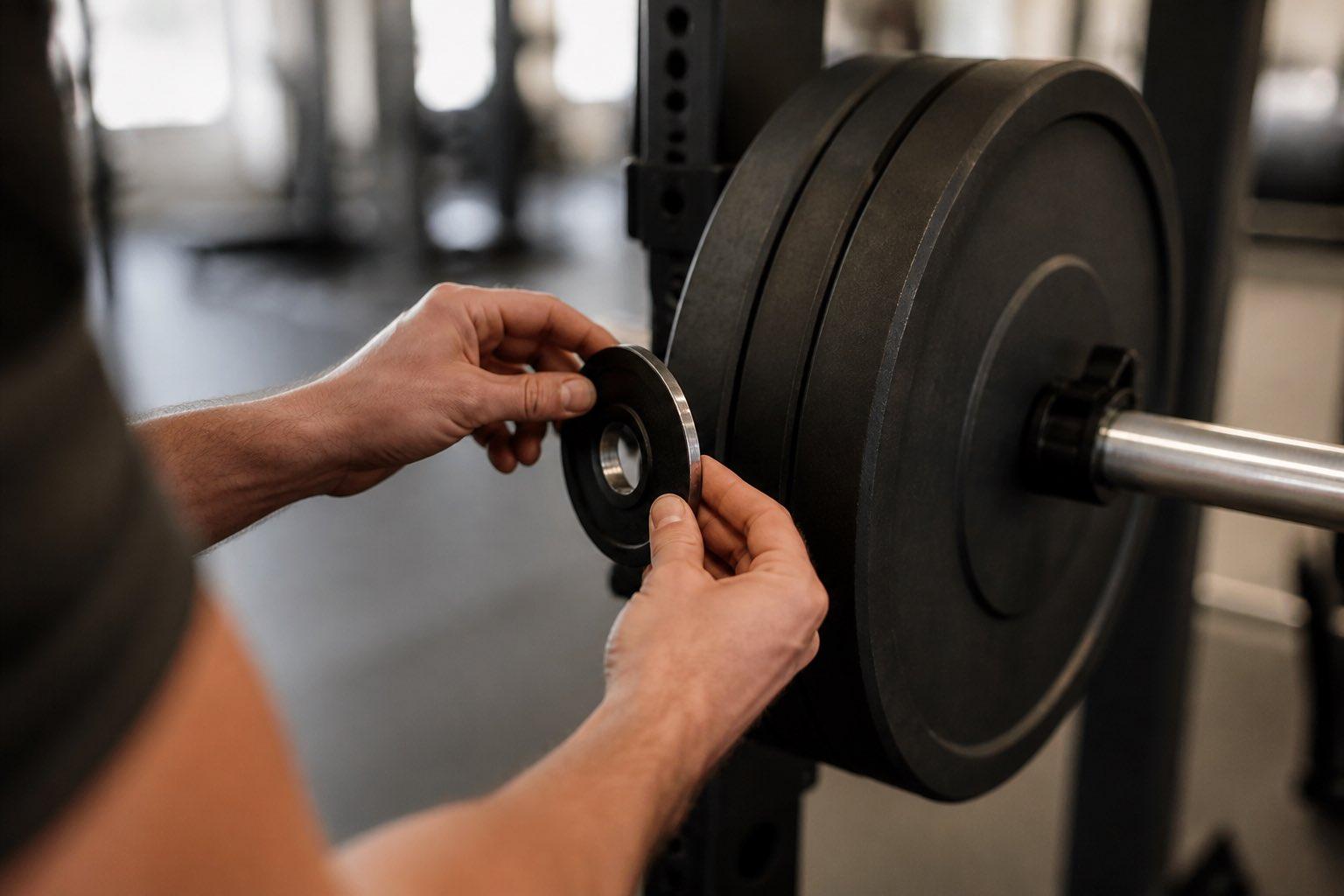
- Fractional plates. A pair of 0.5 kg or 1.25 kg (1 or 2.5 lb) plates is the single best piece of equipment you can own for this. It turns an impossible jump into four small ones.
- One set at a time. Keep the old weight on most sets and put the new weight on the first one. Next week, two sets. Then all of them.
- Add reps past the top of the range. If you are stuck at 10 reps and the next dumbbell is miles away, build to 12 or 13 before you make the jump. You will land softer.
- Change a different lever. On a machine with a 5 kg stack and no half-plate, slow the lowering phase or add a set instead.
Bodyweight and home training
Without a loadable barbell you lose one lever and keep six, which is why bodyweight training keeps working long after people assume it stops.
Reps come first, as always: build a push-up from 3 sets of 8 to 3 sets of 20. Once a movement passes roughly 20 clean reps, extra reps stop building much strength, so change the exercise instead of the count. Push-ups go to feet-elevated, then to one arm assisted. Squats go to split squats, then to a pistol holding something for balance. Each variation drops you back to 8 or 10 reps, which is the same reset that adding a plate gives a barbell lifter.
Tempo is the other lever that does a lot of work here. A push-up lowered over three seconds is meaningfully harder than one dropped in half a second, and it costs nothing but patience. Bands and a loaded backpack cover the rest. If that is your entire setup, there is a full home workout with no equipment, and a dumbbell only plan for when you have a pair and nothing else.
What to do when you stall
First, be sure it is a stall. One bad session is noise. The same lift failing to move for three sessions in a row is a stall, and it is worth working through this list in order, because the top of it is to blame far more often than the bottom.
- Sleep and food. Under seven hours or in a calorie deficit, your lifts stop going up. Nothing in your program fixes this.
- Form. Watch a set back on video. Depth shrinking, range shortening and bounce creeping in all let the weight rise without the work rising, and progress stops where the technique ran out.
- The jump. If the increment is more than about 5% of the bar weight, you are not stalled, you are over-reaching. Microload instead.
- Fatigue. If effort is climbing while reps stay flat, you have accumulated more fatigue than you are clearing. Deload.
- Only now, change the program. If the first four are clean and the lift has not moved in a month, swap the exercise for a close variation and run it for another eight weeks. A stalled flat bench often moves straight away as an incline press.
How to deload
A deload is a planned easy week that lets fatigue clear while keeping the movement pattern fresh. Most lifters avoid them because an easy week feels like going backwards, which is why most lifters grind for a month on weights they could have beaten after seven easy days.
Take one when a lift has stalled through the checklist above, or every 4 to 8 weeks of hard training as routine maintenance.
The protocol is simple: keep the weights roughly the same and cut your sets in half for one week. Three sets become two, four become two. Finish every set well short of failure. If you prefer, the alternative is to keep your sets and drop the weight by about 10%, which is gentler on the joints and slightly less effective at keeping your technique sharp.
Come back the following week at the weight you stalled on, not a heavier one. It should move. That is the signal that fatigue, not strength, was the limit.
Common mistakes
- Adding weight on a schedule. Wednesday is not a reason to add 5 kg. Hitting the top of your rep range is.
- Changing several levers at once. You learn nothing and you have nothing left to change next month.
- Judging a program by one session. Give any change four weeks before you decide it is not working.
- Chasing the weight at the cost of range. Half a rep with more weight on the bar is less work, not more.
- Treating a deload as lost time. It is the week that makes the next eight possible.
- Not logging. You cannot spot a four week trend from memory, and feel is the least reliable instrument you own.
Frequently asked questions
How often should I add weight?
Add weight when you hit the top of your rep range on every set with good form, not on a fixed schedule. In practice that is every one to two weeks for beginners, every two to four weeks for intermediates, and slower than that once you are advanced. The jump should be the smallest one available: 1 to 2.5 kg (2.5 to 5 lb) on upper body lifts and 2.5 to 5 kg (5 to 10 lb) on lower body lifts.
Should I add weight or reps?
Reps first, then weight. Work up through your rep range week by week, and when every set reaches the top of the range, add the smallest weight increment and let the reps drop back down. This is called double progression, and it means you always have a next step instead of being stuck between two weights.
Can I progressively overload without adding weight?
Yes. Adding reps or sets, taking shorter rests, using a fuller range of motion, controlling the lowering phase, and training a muscle more often all increase the demand. This is how bodyweight and home training progress: when 3 sets of 20 push-ups get easy, you move to a harder variation rather than a heavier one.
How do I know if I am actually progressing?
Compare three numbers over four to six weeks rather than session to session. Your estimated one-rep max should trend up, your volume for the exercise should trend up, or the same work should feel easier. If all three are flat for a month, nothing is overloading and something needs to change.
Why have I stopped making progress?
One bad session is noise, but three in a row on the same lift is a stall. The usual causes, in order of how often they are to blame: not enough sleep or food, form drifting as the weight climbs, jumps that are too big for your current strength, and accumulated fatigue. Work through those before changing the program.
Track it in PRZone
Log every set, see last session's numbers while you lift, and catch PRs the moment they happen. Free to start on iPhone and Android, with no ads.
Keep reading
 Training guide
RPE and RIR: How Hard Should Each Set Feel?
What the RPE scale means, how it maps to reps in reserve and to a percentage of your 1RM, how accurate your ratings really are, and what to do with them.
 Training guide
How Long to Rest Between Sets? The Numbers That Hold Up
How long to rest for strength, muscle and endurance, why the old 30 to 90 second rule for muscle growth no longer holds, and what to do when time is short.
 Workout routine
Push Pull Legs Routine: 3 and 6 Day Plans
A complete push pull legs routine with 3 and 6 day schedules, sets and reps for every exercise, and a simple way to add weight week after week.
 Workout routine
Upper Lower Split: 4 Day Workout Plan
A 4 day upper lower split with two upper and two lower workouts, sets and reps for every exercise, and a simple plan for adding weight.
 Workout routine
Full Body Workout for Beginners: 3 Days a Week
A simple 3 day full body workout for beginners, with two alternating routines, sets and reps, and a week by week plan for getting stronger.