
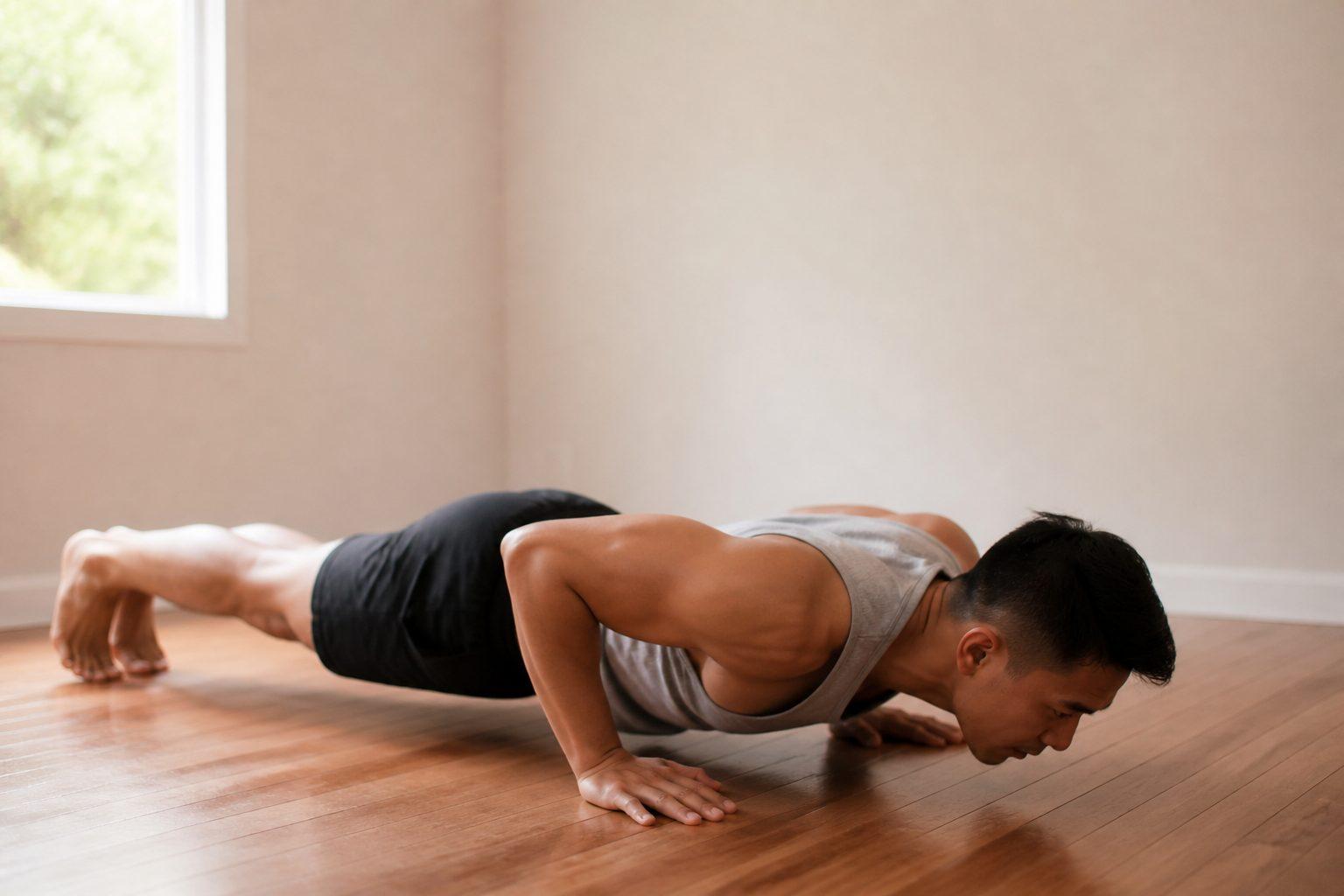
The problem with home workouts is not the first month, it is the sixth. Press-ups that were hard in January are a warm-up by summer, and most plans have nothing to say about that. This one is built around the answer: you cannot add weight, so you change leverage. Below is a three day routine and a harder version of every exercise in it.
Can you actually build muscle without equipment?
Yes, with one honest caveat.
Muscle responds to hard sets rather than to heavy weight specifically. A review of 21 training studies, all of which took sets to failure, found muscle growth was similar whether the load was light or heavy, while heavy loads were clearly better for maximal strength. Bodyweight training is light load training, so it sits on the good side of that finding.
The most direct test is a small trial comparing push-ups against bench pressing at a matched light load, twice a week for eight weeks. Both groups increased chest and triceps thickness and both got stronger, with no clear advantage either way. It was nine people per group and all of them untrained, so treat it as supporting evidence rather than proof, but it points the same direction as the broader research.
The caveat is the ceiling. Nothing physiological stops bodyweight training from building muscle; what stops it is running out of harder variations, and that happens sooner for your back and legs than for your chest.
The weekly schedule
| Day | Session |
|---|---|
| Monday | Day 1 |
| Tuesday | Rest |
| Wednesday | Day 2 |
| Thursday | Rest |
| Friday | Day 3 |
| Saturday | Rest |
| Sunday | Rest |
Every session covers the same five patterns: a push, a pull, a squat, a hinge and a brace. The three days rotate the variations so nothing gets stale and every muscle is trained three times a week.
The routine
Pick the hardest variation of each exercise where you can still reach the bottom of the rep range with clean form. Rest 90 seconds between sets, or 2 minutes if you are breathing hard. Stop each set 1 to 2 reps short of failure.
Day 1
5 exercises · 17 sets| Exercise | Sets | Reps | Rest |
|---|---|---|---|
| Push-up | 4 | 8-20 | 90 s |
| Inverted row | 4 | 8-15 | 90 s |
| Squat | 3 | 15-25 | 90 s |
| Single leg hip thrust | 3 | 10-15 each | 60 s |
| Plank | 3 | 30-60 s | 60 s |
Day 2
5 exercises · 17 sets| Exercise | Sets | Reps | Rest |
|---|---|---|---|
| Push-up, feet elevated | 4 | 8-15 | 90 s |
| Inverted row, feet forward | 4 | 8-15 | 90 s |
| Reverse lunge | 3 | 10-15 each | 90 s |
| Glute ham raise | 3 | 6-12 | 90 s |
| Side plank | 3 | 20-45 s each | 60 s |
Day 3
5 exercises · 18 sets| Exercise | Sets | Reps | Rest |
|---|---|---|---|
| Pike push-up | 4 | 6-12 | 90 s |
| Inverted row, feet forward | 4 | 8-15 | 90 s |
| Bulgarian split squat | 4 | 8-15 each | 90 s |
| Back extension | 3 | 10-20 | 60 s |
| Reverse plank | 3 | 20-45 s | 60 s |
The inverted row is the one exercise here with no single obvious setup. A table row is done lying under a sturdy table, gripping the edge and pulling your chest to it. A towel row is a towel looped around a door handle on a closed door, leaning back and pulling yourself upright. Neither is as good as a pull-up bar, which is the one purchase worth making.
How to make any bodyweight exercise harder
This is the section the plan lives or dies on. Five ways to add difficulty without adding a single kilo, listed from smallest change to largest:
- Slow the lowering phase. Three seconds down turns a comfortable set of 15 into a hard set of 10. The cheapest progression there is, and it works on everything.
- Pause at the bottom. Two seconds in the hardest position removes the bounce you were getting for free.
- Change the angle. Raise your feet on a push-up and more of your weight moves onto your arms. Walk your feet further forward under an inverted row and the same happens for your back.
- Narrow or widen your base. Hands closer together on a push-up loads the triceps harder. Feet together on a squat makes balance part of the work.
- Drop to one limb. The big one. Going from two legs to one roughly doubles the load, which is why single leg work is all over the plan above.
A worked example, because the ladder is easier to see than to describe:
| Stage | Push variation | Roughly |
|---|---|---|
| 1 | Hands on a worktop | Easiest |
| 2 | Hands on a chair | |
| 3 | Push-up on the floor | |
| 4 | Feet on a chair | |
| 5 | Feet high, hands narrow | |
| 6 | One arm, feet wide | Hardest |
When you reach the top of the rep range on every set, move up a stage and your reps drop again. That is the whole of progressive overload, just expressed as leverage rather than plates.
Track the variation, not just the reps
Save the three days to PRZone and log which version you did. Next session shows you exactly what you managed last time, so you know when it is time to move up a stage. Free to start, no ads.
The two hard problems
Pulling. There is no good bodyweight row without something to pull against. A table works, a towel in a door works, and both run out of difficulty long before your back does. This is the single strongest argument for buying a pull-up bar, which costs little and solves the problem permanently.
Legs. Squats get easy fast, because your legs are strong and your bodyweight is fixed. Single leg work carries you much further than most people expect: a Bulgarian split squat, a single leg Romanian deadlift and a Nordic curl are all genuinely hard for anyone. Past that, you need load.
Everything else, chest, shoulders, triceps and midsection, has enough variations to last years.
When to stop and buy something
Three signs it is time:
- You are at the hardest variation you can do with good form on an exercise and still hitting the top of the rep range on every set.
- Your sets have drifted above 25 reps and the session has become cardio.
- Pulling is obviously lagging behind pushing, which it will, because the pushing ladder is longer.
A pull-up bar fixes most of it. A pair of adjustable dumbbells fixes the rest, and a dumbbell plan is the natural next step from here.
Common mistakes
- Chasing rep counts. Fifty push-ups is an endurance feat, not a muscle building set. Find a harder version and go back to ten.
- Doing it every day because it is only bodyweight. The sets are hard, so the recovery is real. Three days a week with rest between beats seven.
- Circuits with no rest. Moving straight between exercises makes the session feel harder while making each set worse. Rest properly between sets.
- Never progressing the lower body. Two legged squats stop doing much within weeks. Single leg work is not optional here.
- Not recording which variation you used. "Push-ups, 3 x 12" tells you nothing six weeks later if you cannot remember whether your feet were up.
Frequently asked questions
Can you build muscle with bodyweight exercises only?
Yes, for as long as you can keep making the exercises harder. The research on training load finds that light and heavy sets build muscle about equally when they are taken close to failure, and one trial comparing push-ups against a matched light bench press found similar gains in chest thickness and strength over eight weeks. The ceiling is practical rather than physiological: eventually you run out of harder variations, particularly for the legs and back.
How do you progress a bodyweight workout?
You change leverage instead of weight. Elevate your feet on a push-up to shift more of your body onto your arms. Narrow your hands. Drop a squat to one leg. Slow the lowering phase to three or four seconds. Each of these makes the same bodyweight feel heavier, which is the same thing adding a plate does.
How many reps should a bodyweight workout be?
Pick a variation hard enough that you reach 1 to 2 reps from failure somewhere between 8 and 20 reps. If you can do 30 push-ups, the answer is not more push-ups, it is a harder push-up. Sets much above 20 reps still build muscle but they take far longer and the limit becomes your lungs rather than the muscle you are training.
Is a 30 minute home workout enough?
Three focused 30 minute sessions a week is enough to build noticeable muscle and strength, especially in your first year. What matters is that the sets are genuinely hard and that the difficulty goes up over time. A 30 minute session of hard work beats an hour of circuits you never make harder.
What is the hardest muscle to train without equipment?
Your back. Every pulling movement needs something to pull against, and a table or a towel in a door only goes so far. If you buy one thing, make it a pull-up bar. Legs are the second problem, though single leg squats solve that much further than most people get to.
Should I do a home workout every day?
No. Muscle is built during recovery, and a hard bodyweight session needs the same rest as a hard gym session. Three sessions with a day between them works better than seven in a row. If you want to move on the other days, walk.
Track it in PRZone
Log every set, see last session's numbers while you lift, and catch PRs the moment they happen. Free to start on iPhone and Android, with no ads.
Keep reading
 Workout routine
Dumbbell Only Workout: A 3 Day Plan That Needs No Rack
A full body dumbbell workout for three days a week, with a swap for every exercise that needs a bench, and how to keep progressing once the weights run out.
 Workout routine
Full Body Workout for Beginners: 3 Days a Week
A simple 3 day full body workout for beginners, with two alternating routines, sets and reps, and a week by week plan for getting stronger.
 Training guide
Progressive Overload: How to Apply It and Know It Works
The seven ways to make training harder, which one to change first, the three numbers that prove it is working, and what to do when you stall.