
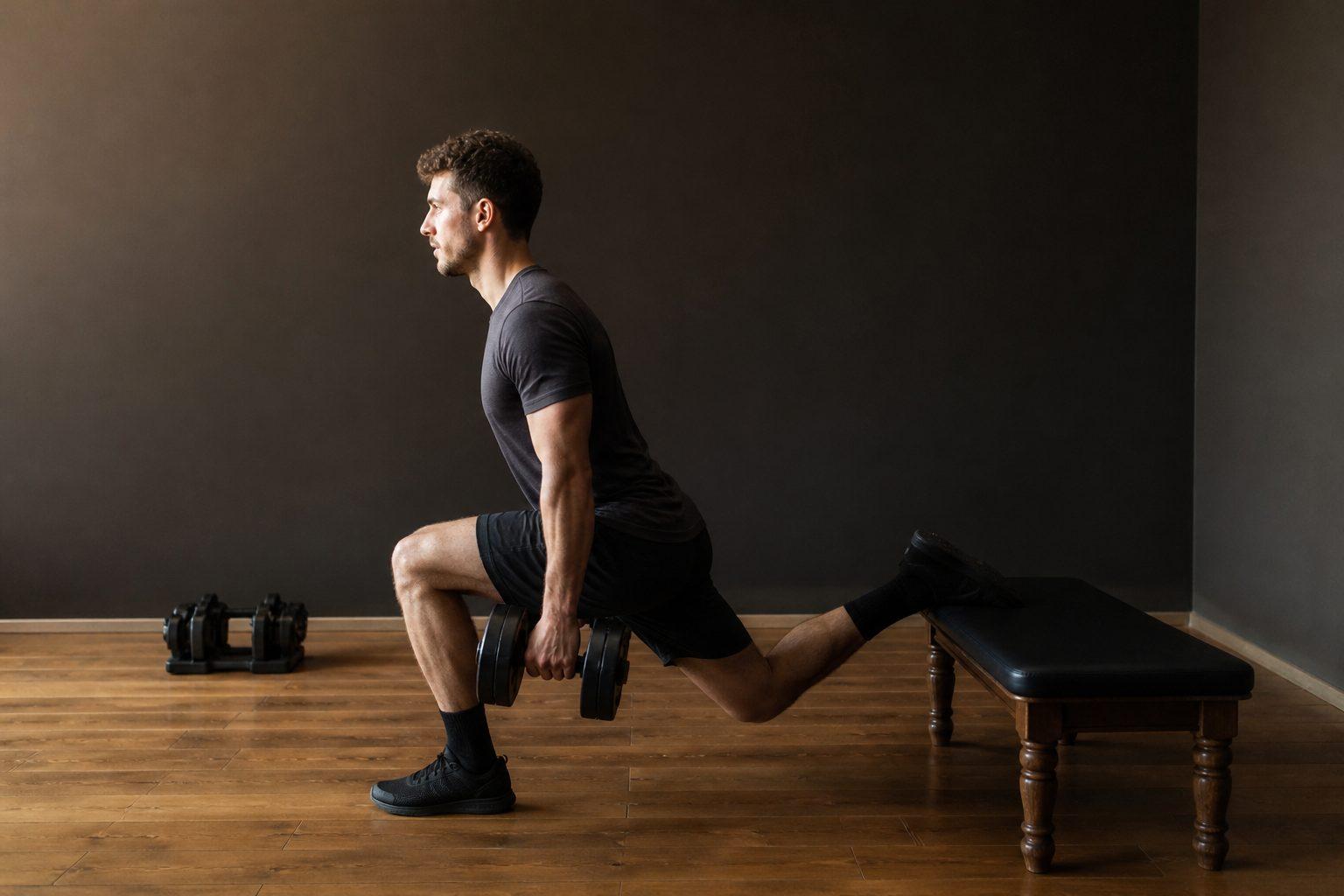
Most "dumbbell only" plans quietly assume you own a bench, and half of them fall apart the moment your heaviest pair stops being heavy. This one handles both. Below is a three day full body routine, a swap for every exercise that needs a bench, and a plan for what to do when you run out of weight, which is the real problem with training on dumbbells.
What you actually need
One pair of adjustable dumbbells. That is the whole list.
A bench is the only other thing worth owning, and it is optional: every exercise below that uses one has a floor or standing alternative in the no-bench column. If you are buying, adjustable dumbbells that reach at least 20 kg (45 lb) per hand will carry you a long way. Fixed pairs look cheaper until you count how many you need.
The weekly schedule
Three full body sessions, rotated A, B, C, with a rest day between each one.
| Day | Session |
|---|---|
| Monday | Workout A |
| Tuesday | Rest |
| Wednesday | Workout B |
| Thursday | Rest |
| Friday | Workout C |
| Saturday | Rest |
| Sunday | Rest |
Each muscle gets trained three times a week across the three sessions, which is more exposure than most gym splits give you. If you want a fourth day, do not repeat a workout. Keep rotating: A, B, C, A, then B, C, A, B the following week. The days shift and nothing gets trained twice in a row.
The dumbbell routine
Three different sessions, each covering the whole body from a slightly different angle. Rest 2 to 3 minutes after the first two exercises in each workout and 60 to 90 seconds after the rest.
Take every working set to within 1 to 2 reps of failure. On dumbbells this matters more than it does in a gym, because the load is capped. Effort is what you have left to spend when weight runs out.
Workout A
6 exercises · 19 sets| Exercise | Sets | Reps | Rest |
|---|---|---|---|
| Dumbbell squat | 4 | 8-12 | 2-3 min |
| Dumbbell bench press | 4 | 8-12 | 2-3 min |
| Bent over one arm row | 3 | 10-12 each | 90 s |
| Romanian deadlift | 3 | 10-15 | 90 s |
| Lateral raise | 3 | 12-20 | 60 s |
| Hammer curl | 2 | 10-15 | 60 s |
Workout B
6 exercises · 18 sets| Exercise | Sets | Reps | Rest |
|---|---|---|---|
| Bulgarian split squat | 4 | 8-12 each | 2-3 min |
| Standing overhead press | 4 | 8-12 | 2-3 min |
| Incline row, chest supported | 3 | 10-15 | 90 s |
| Single leg bridge | 3 | 12-20 each | 90 s |
| Incline dumbbell curl | 2 | 10-15 | 60 s |
| Overhead triceps extension | 2 | 10-15 | 60 s |
Workout C
6 exercises · 20 sets| Exercise | Sets | Reps | Rest |
|---|---|---|---|
| Dumbbell deadlift | 4 | 8-12 | 2-3 min |
| Incline dumbbell press | 4 | 8-12 | 2-3 min |
| Dumbbell pullover | 3 | 10-15 | 90 s |
| Dumbbell lunge | 3 | 10-12 each | 90 s |
| Reverse fly | 3 | 12-20 | 60 s |
| Standing calf raise | 3 | 12-20 | 60 s |
Each session runs about 45 to 55 minutes. "Each" in the reps column means per side, so 10-12 each on a one arm row is 10 to 12 with the left and then the same with the right.
Training without a bench
Seven exercises in the plan use one. Here is what to do instead, and none of these are compromises worth worrying about.
| Exercise | Without a bench |
|---|---|
| Dumbbell bench press | Floor press, lying on your back with knees bent |
| Incline dumbbell press | Standing overhead press, or a press with your back against a wall |
| Bent over one arm row | Bent over row with your free hand on a chair or windowsill |
| Incline row, chest supported | Bent over two arm row, kept strict |
| Incline curl | Seated curl on a chair, or standing strict |
| Dumbbell pullover | Floor pullover, one dumbbell, hips down |
| Bulgarian split squat | Rear foot on a chair, sofa edge or bottom stair |
The floor press is the one people underrate. Your upper arm stops when your triceps hits the floor, which cuts the bottom of the range, but it lets you press heavy without a spotter and it is kinder to the shoulder than a deep bench press. It is a genuinely good exercise, not a stand-in.
When the dumbbells get too light
This is the problem that ends most home training, and it arrives faster than people expect. You buy 20 kg dumbbells, and within a few months a set of 12 dumbbell squats is a warm-up.
The thing to understand is that the weight is not what grows the muscle. The hard set is. A review of 21 studies that all took sets to failure found that muscle growth was similar across light and heavy loads, while heavy loads were clearly better for maximal strength. So the cap on your dumbbells is a cap on how strong you can get, not on how much muscle you can build, as long as you keep finishing sets close to failure.
That gives you four levers, roughly in the order you should reach for them:
- Add reps. Work up to the top of the range on every set before anything else changes. Twelve reps where you used to get eight is real progress, not a consolation.
- Go to one limb. This is the biggest jump available and it costs nothing. A Bulgarian split squat puts most of your body plus the dumbbells through one leg, so a pair you can squat for 20 becomes genuinely hard for 8.
- Slow the lowering phase. Three seconds down on every rep makes the same weight much harder, and the lowering phase is where most of the growth stimulus lives. It is a lever on its own, not a trick.
- Add sets. Last resort, because it is the one that costs time. Going from 3 sets to 4 on your main lifts adds real work to the week.
When you have used all four on an exercise, that exercise has given you what it has. Swap it for a harder version rather than trying to force the same movement forever.
The plan, already loaded
Save all three workouts to PRZone and every set shows what you lifted last time, so you always know whether this week beat last week. Free to start, no ads.
What dumbbells genuinely cannot do
Worth being straight about, because most articles on this topic oversell.
You will not get maximally strong. A squat loaded with two dumbbells is limited by what your hands and shoulders can hold, not by what your legs can lift. Serious lower body strength needs a bar on your back. If your goal is a big squat or deadlift number, dumbbells will get you started and then stop being enough.
Your grip becomes the limit on pulling. Rows and deadlifts start failing in your hands before your back is done. A cheap pair of lifting straps fixes it, and using them is not cheating, it is removing the wrong limiting factor.
Loading the legs is awkward at the top end. The upper body scales fine, because a press or a row uses roughly the weight you would use in a gym anyway. Legs are where the gap opens, which is why this plan leans on split squats, lunges and bridges rather than trying to make two dumbbells do the work of a loaded barbell.
None of that stops a dumbbell plan being the right call. It just means you should know which goal you are buying.
Common mistakes
- Treating a bench as mandatory. It changes four exercises and none of the replacements are meaningfully worse. Do not postpone starting.
- Staying at the same weight because it is the heaviest pair you own. That is the cue to change the exercise, not to keep repeating the same set.
- Skipping the single leg work because it is uncomfortable and slow. It is the main reason this plan keeps working past month three.
- Doing all three workouts on consecutive days. You get the same sessions with worse performance in each one. Keep a rest day between them.
- Not writing anything down. With a capped load, progress shows up as reps and tempo rather than plates, and those are much easier to lose track of.
Frequently asked questions
Can you build muscle with just dumbbells?
Yes. Muscle responds to hard sets, not to the shape of the handle. The honest limit is maximal strength: a heavy barbell squat loads your legs in a way two dumbbells cannot, so your one rep max will climb more slowly than it would with a full rack. For size, dumbbells are not the bottleneck.
What weight dumbbells should I buy?
A single pair of adjustable dumbbells that reach at least 20 kg (45 lb) each covers almost everything in this plan. Fixed dumbbells are a worse buy: you need roughly six pairs to cover the range between a lateral raise and a row, and you will outgrow the light end within months.
Do I need a bench for a dumbbell workout?
No, but it widens what you can do. A bench lets you press at a decline-free angle, support one hand for rows, and raise your rear foot for split squats. Without one, floor presses and standing or chest-supported alternatives cover the same muscles, which is what the no-bench column of this plan uses.
How many days a week should I do a dumbbell workout?
Three, on non-consecutive days, is the sweet spot for this plan. Each session trains your whole body, so three sessions give every muscle three exposures a week and leave a rest day between them. Four days works too if you rotate the three workouts continuously rather than repeating one.
What do I do when the dumbbells get too light?
Change the exercise before you change the plan. Move from two legs to one, as in going from a two legged dumbbell squat to a Bulgarian split squat, which roughly doubles the load on the working leg. Slow the lowering phase to three seconds. Or add reps until you are at the top of the range on every set, then make one of those changes.
Is a dumbbell workout as good as a barbell workout?
For muscle, close enough that the difference rarely matters. For maximal strength, no, because the loads are smaller and you have to get the weight into position yourself, which limits the heaviest lifts. Dumbbells do give you a longer range of motion on pressing and force each side to work on its own, which evens out imbalances a barbell lets you hide.
Track it in PRZone
Log every set, see last session's numbers while you lift, and catch PRs the moment they happen. Free to start on iPhone and Android, with no ads.
Keep reading
 Workout routine
Home Workout With No Equipment: A Plan That Keeps Working
A three day bodyweight routine you can do in a bedroom, with a harder version of every exercise so the plan still challenges you in month six.
 Workout routine
Full Body Workout for Beginners: 3 Days a Week
A simple 3 day full body workout for beginners, with two alternating routines, sets and reps, and a week by week plan for getting stronger.
 Training guide
Progressive Overload: How to Apply It and Know It Works
The seven ways to make training harder, which one to change first, the three numbers that prove it is working, and what to do when you stall.